How to choose outfits for your family session
If there's one thing that causes more pre-session stress than anything else, it's outfits. I hear it constantly: the session is booked, the location is set, the kids are theoretically on board - and then someone opens the closet and the whole thing unravels. What do we wear? Does it have to match? What if my husband refuses to wear anything other than jeans? What if I can't find anything that feels right on me? These are real questions, and they deserve real answers - not a mood board with $400 linen sets that no actual family owns or wears. This is my practical, honest guide to dressing your family for photos, built entirely on what I've seen work (and not work) over hundreds of sessions.
Start with a color palette, not matching outfits.
The number one outfit mistake families make is trying to match too precisely. Everyone in the same shade of navy, or the same pattern, or - and I say this with love - the same branded family vacation t-shirt. Matchy-matchy outfits flatten the visual interest of a photo and tend to make everyone look like they're posing rather than existing. What works instead is a coordinated palette: a family of colors that complement each other without being identical. Pick two or three tones that look good together - say, warm rust, cream, and olive - and let each person wear their version of that palette in their own style. The result looks intentional and cohesive without looking like a uniform.
Let one person anchor the palette, then build around them.
The easiest way to coordinate a family is to start with one outfit - usually mom's, because women's clothing tends to have more color and pattern variety - and build everyone else's look around it. If mom is wearing a dusty mauve floral dress, pull the dusty mauve for dad's shirt, bring in a coordinating neutral for the kids. You're not copying the outfit - you're borrowing its colors and distributing them across the group. This method almost always produces a cohesive look, and it takes the guesswork out of where to start.
Avoid these specific things.
There are a handful of outfit choices that consistently cause problems in photos, and it's worth knowing them upfront. Bright white and bright white only - against certain backgrounds it overexposes or disappears, and it shows every wrinkle and grass stain within the first five minutes of a session with kids. Neon or very saturated colors pull focus away from faces, which is where you want the eye to go. Busy small-print patterns - tiny stripes, small checks, intricate florals - can create a visual vibration in photos called moiré that looks distracting on screen and in print. Logos and branded graphics on clothing pull the eye to text when it should be on people. None of these are absolute rules, but they're worth knowing before you pull something out of the closet.
Neutrals and earth tones are your best friends.
If you're ever in doubt about a color, lean neutral. Cream, ivory, tan, taupe, warm gray, soft white, camel, khaki - these tones photograph beautifully, work in almost any season, and have the very useful quality of receding into the background rather than competing with faces and expressions. Earth tones - terracotta, sage, dusty blue, warm olive, burgundy, rust - are equally reliable and tend to photograph especially well in outdoor Michigan settings, where you're often surrounded by greens, browns, and the warm tones of changing seasons. When in doubt: neutrals and earth tones. You will almost never regret them.
Think about texture, not just color.
One of the things that makes a family portrait visually rich is variety in texture - and it's something most people never think about. A chunky knit sweater, a flowy linen dress, a denim jacket, a soft jersey tee all read differently in photos even if they're all in the same neutral palette. Mixing textures adds depth and visual interest that makes the final images feel layered rather than flat. This is especially relevant for fall and winter sessions, where texture is everywhere and easy to incorporate. A family where every person is wearing a smooth, flat-fabric top can look a little one-dimensional even if the colors are perfect. Give the clothes something interesting to say.
Dress for the season you're actually in.
This sounds obvious, but I see it ignored regularly. Wearing a light, flowy sundress in October because it's your favorite dress is going to produce images where you look cold and the outfit doesn't match the environment. Wearing heavy layers in August is going to make everyone uncomfortable and sweaty within twenty minutes. Seasonal dressing matters partly for comfort - a comfortable family photographs better than a miserable one - and partly because outfit and environment together tell a story. When they match, everything feels cohesive. When they conflict, something in the image always feels slightly off, even if you can't immediately identify why.
Think about what you actually feel good in.
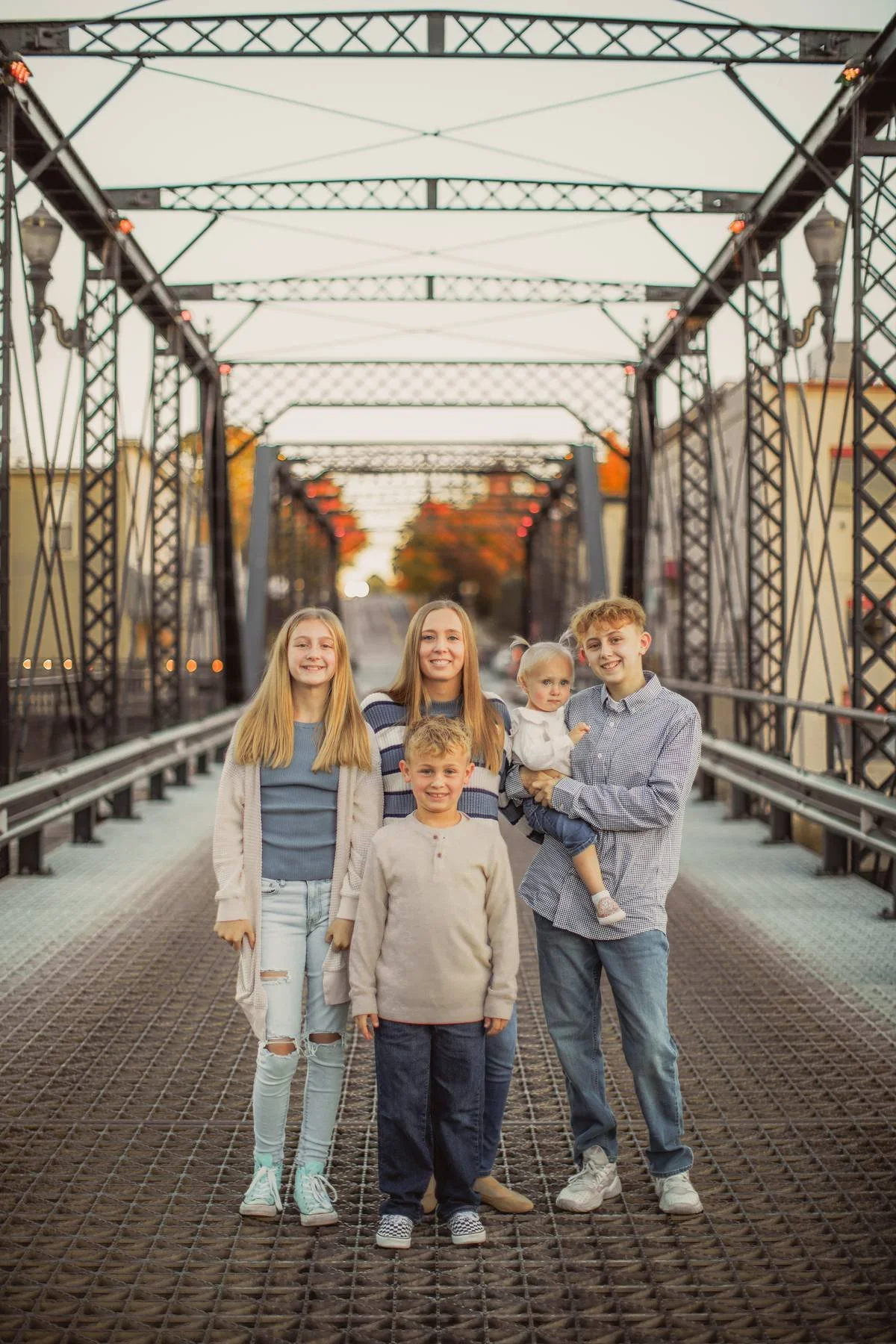
Here's a piece of advice that sometimes gets lost in all the practical guidance: wear something you feel like yourself in. Not the thing you think you should wear for photos, not the outfit you bought specifically for this session and have never worn before, not the dress that fits perfectly when you're standing up straight and holding your breath. The thing you feel comfortable and genuinely good in. Confidence is not invisible in photographs - it shows up in posture, in expression, in how naturally you carry yourself. If you spend the session tugging at something, or wishing you'd worn something else, that feeling tends to make its way into the frames. Feeling good in your outfit is not vanity. It's practical.
Give the kids some grace - within limits.
Children's outfits are where the best-laid plans most often fall apart. The dress your daughter was excited about two weeks ago is now "itchy and awful." Your son has decided he will only wear his favorite dinosaur shirt. I understand this. And to a point, I think it's okay to let kids have some say in what they wear - a child who feels good in their outfit is going to be a more relaxed, cooperative subject than one who is miserable in something scratchy and stiff. That said, there are reasonable limits. The dinosaur shirt might not coordinate with the family palette. The tutu over jeans might be a hill you're willing to die on or not. My suggestion: let kids choose between two or three pre-approved options, so they have agency within a guardrail. It reduces the morning-of battle considerably.
Bring a backup option if you can.
For sessions with young children especially, I always recommend bringing one backup outfit - at least for the littlest ones who are most likely to have a wardrobe malfunction before we even finish the first location. A spilled snack, a fall in the grass, an unexpected puddle - these things happen, and they happen on photo days with particular reliability. A clean backup in the car isn't pessimism. It's just good parenting and smart planning. You don't have to use it. But you'll be very glad you have it if you do.
Don't wait until the week before to figure this out.
Outfit planning is one of those things that feels manageable until suddenly it isn't, usually around 9pm the night before your session when nothing fits and the kids are melting down and you've ordered three things from Amazon that haven't arrived yet. Give yourself at least two to three weeks before your session to pull outfits together, try them on, take a mirror selfie of the family together to see how they look as a group, and make any adjustments. If you're stuck, send me a photo - I genuinely love helping clients work through outfit questions, and a fresh set of eyes can make the decision a lot easier. Getting this sorted early means you arrive to your session relaxed and ready, instead of frazzled and second-guessing.
There are no perfect outfits, and there are no perfect photos. But there are outfits that help you feel like yourselves, that coordinate without constraining, that let the real moments of your family - the laughter, the chaos, the love - be the main event. That's what I'm always aiming for. The clothes are just the frame. What matters is what's inside it.
